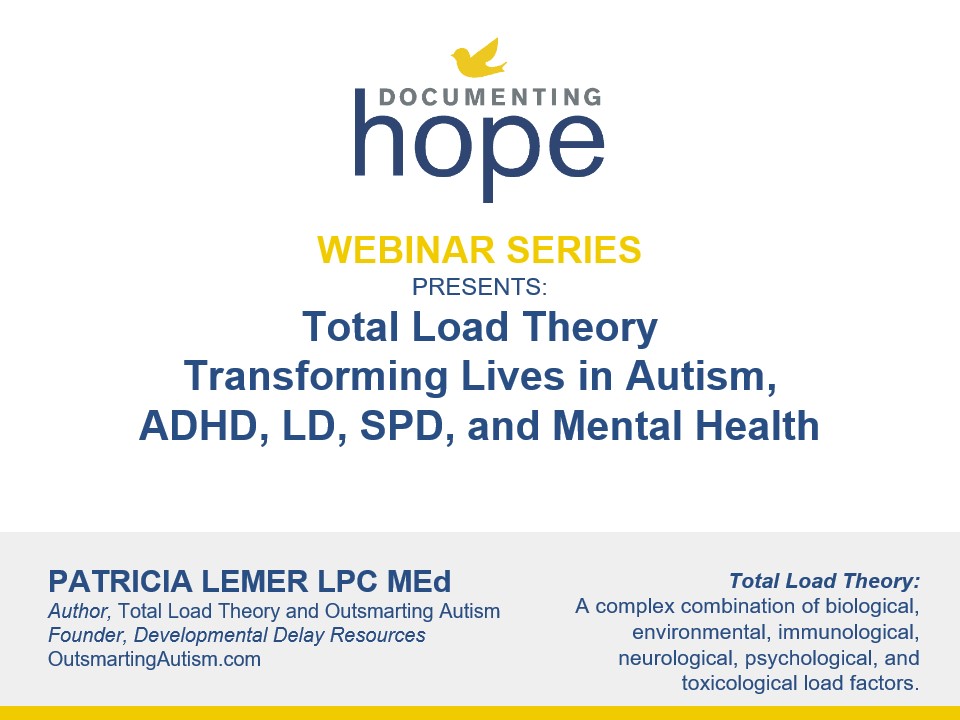
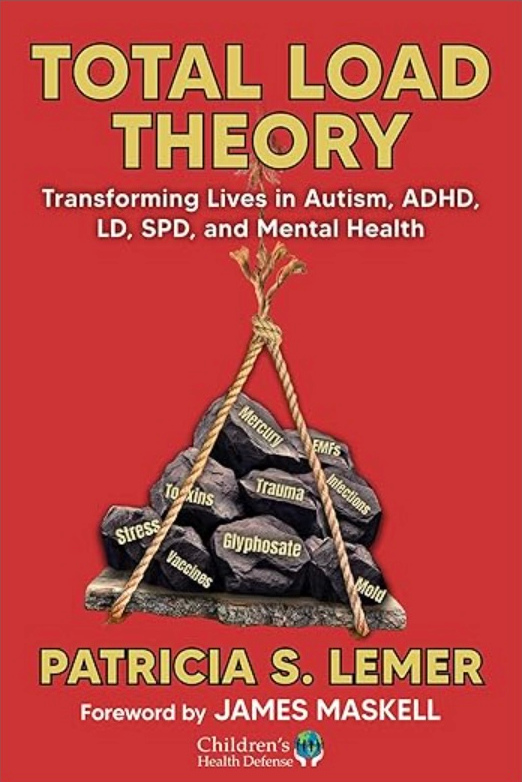
What Is Total Load Theory?
Total load theory is a conceptual framework used to understand the synergistic and cumulative impact of root causes and environmental and lifestyle stressors on a person’s health. It postulates that each individual stressor adds to the total load that a body must manage over time. Because a body has limited resources and only so much capacity to handle these stressors, there will be a point at which the total load exceeds these resources, and this is when health symptoms typically emerge.
What’s in the Total Load Theory Book?
Root Causes and Stressors
In this latest of Patty Lemer’s books, she dives into a host of root causes and stressors that are behind the diagnoses of neurodevelopmental disorders such as autism, ADHD, Sensory Processing Disorder, learning disabilities and mood/emotional disorders; autoimmune disorders, asthma, allergies and more. Among these root causes are:
Patty discusses how to assess, reduce, eliminate, remediate environmental, physical, biological, lifestyle and other types of health stressors that children today experience more than any other generation.
Therapies and Supports
It would be an awful thing to tell parents about all of the potential root causes and stressors without providing information about how to address them with therapies and supports, and that’s what’s next in the book. She understands that a body cannot heal unless it is in a state of calm and that so many of today’s children are in a state of nervous-system dysregulation due to:
- Cell danger response
- Mast Cell Activation Syndrome
Cleaning up the diet and implementing special diets are key to healing the body (which includes the brain!) and also to addressing the immune dysregulation and mitochondrial dysfunction that these children so often have. The book contains a section on immunizations for those who wish to know more.
Patty offers a three-pronged approach to healing that addresses factors such as strengthening immunity, lowering chronic inflammation and treating potential underlying conditions such as mold/mycotoxin illness, Lyme disease and PANS/PANDAS with stem cell therapy, detoxification and bioregulatory medicine. This type of medicine includes (and Patty’s book discusses):
- Oxygen therapies such as HBOT
- Pulsed Electromagnetic Frequency Therapy (PEMF)
- Flower remedies
- Essential oils
Sensory-processing and motor-planning challenges are fully addressed, as one would expect from Patty, and she also includes jam-packed edifications about:
No Patty discussion or book would be complete without explanations about social-emotional skills, academics and transitioning out of school and into life, and this book is no exception. She also includes one of her favorite subjects: information about how to have a healthy baby.
In Conclusion
Beth Lambert’s blurb about his book sums it up well: “Patricia Lemer’s Total Load Theory is the ultimate resource for parents and practitioners looking to understand not only why children are so sick today but also how these conditions can be fully reversed. This book gives tremendous hope!”
About Patricia S. Lemer LPC MEd
Patricia S. Lemer is a licensed professional counselor, holding a Masters of Education in counseling and learning disabilities from Boston College and a Masters in Business from Johns Hopkins University. She practiced as an educational diagnostician for over 40 years.
She was a co-founder and served as Executive Director of the international non-profit organization Developmental Delay Resources (DDR). After DDR merged with Documenting Hope (formerly called Epidemic Answers), she became Chairman of the Board. When she retired from the board, she became an emeritus board member.

She is the author of three books, including Outsmarting Autism, Updated and Expanded: Build Healthy Foundations for Communication, Socialization, and Behavior at All Ages and Total Load Theory: Transforming Lives in Autism, ADHD, LD, SPD, and Mental Health.
Lemer wrote over 50 editorials for "New Developments," the quarterly newsletter of Developmental Delay Resources (DDR), from 1995 - 2009. When DDR wound down, she wrote an online blog, "After the Diagnosis, Then What?" from 2009-2017. Her articles and blogs have been updated and archived on the Documenting Hope website.
Since 2019, Patricia Lemer has recorded a bimonthly podcast, "The Autism Detective." In these hour-long shows, she interviews parents and professionals about their experiences in maximizing the potential of individuals on the autism spectrum. Over 100 episodes are available on Spotify and other online platforms. To learn more, go to PatriciaLemer.com and OutsmartingAutism.com
Still Looking for Answers?
Visit the Documenting Hope Practitioner Directory to find a practitioner near you.
Join us inside our online membership community for parents, Healing Together, where you’ll find even more healing resources, expert guidance, and a community to support you every step of your child’s healing journey.
Sources & References
Adams, J.B., et al. Mercury in first-cut baby hair of children with autism versus typically-developing children. Toxicological & Environmental Chemistry. 2007 Jun;70(12):1046-51.
Adams, J.B., et al. Mercury, Lead, and Zinc in Baby Teeth of Children with Autism Versus Controls. Journal of Toxicology and Environmental Health. 2007 Jun;70(12):1046-51.
Alampi, J.D., et al. Gestational Exposure to Toxicants and Autistic Behaviors using Bayesian Quantile Regression. Am J Epedemiol. 2021 Sep 1;190(9):1803-1813.
Aldad, T.S., et al. Fetal Radiofrequency Radiation Exposure From 800-1900 Mhz-Rated Cellular Telephones Affects Neurodevelopment and Behavior in Mice. Sci Rep. 2012;2:312.
Banks, W.A., et al. Aluminum-induced neurotoxicity: alterations in membrane function at the blood-brain barrier. Neurosci Biobehav Rev. 1989 Spring;13(1):47-53.
Beese, S., et al. Allostatic Load Measurement: A Systematic Review of Reviews, Database Inventory, and Considerations for Neighborhood Research. Int J Environ Res Public Health. 2022 Dec 18;19(24):17006.
Bernard, S., et al. Autism: a novel form of mercury poisoning. Med Hypotheses. 2001 Apr;56(4):462-71.
Bethell, C., et al. A National and State Profile of Leading Health Problems and Health Care Quality for US Children: Key Insurance Disparities and Across-State Variations. Academic Pediatrics, May–June 2011, Volume 11, Issue 3, Supplement, p. S22–S33.
Björvang, R.D., et al. Mixtures of persistent organic pollutants are found in vital organs of late gestation human fetuses. Chemosphere. 2021 Nov;283:131125.
Braun, J.M., et al. Association of Environmental Toxicants and Conduct Disorder in U.S. Children: NHANES 2001-2004. Environ Health Perspect. 2008 Jul;116(7):956-62.
Braun, J.M., et al. Exposures to environmental toxicants and attention deficit hyperactivity disorder in U.S. children. Environ Health Project. Dec 2006;114(12):1904-1909.
Choi, A.L., et al. Developmental Fluoride Neurotoxicity: A Systematic Review and Meta-Analysis. Environ Health Perspect. 2012;120(10).
Cohen, Patricia. Roundup Maker to Pay $10 Billion to Settle Cancer Suits. The New York Times. 24 Jun 2020.
Condon, E.M. Chronic Stress in Children and Adolescents: A Review of Biomarkers for Use in Pediatric Research. Biol Res Nurs. 2018 Oct;20(5):473-496.
Deisher, T.A., et al. Impact of environmental factors on the prevalence of autistic disorder after 1979. J Public Health and Epidemiology. Sep 2014;6(9):271-286.
Deth, R., et al. How environmental and genetic factors combine to cause autism: A redox/methylation hypothesis. Neurotoxicology. 2008;29(1):190-201.
Environmental Working Group. Body Burden: The Pollution in Newborns. 14 Jul 2005.
Geier, M.R., et al. The potential importance of steroids in the treatment of autistic spectrum disorders and other disorders involving mercury toxicity. Med Hypotheses. 2005;64(5):946-54.
Grandjean, P., et al. Developmental neurotoxicity of industrial chemicals. Lancet. 2006 Dec 16;368(9553):2167-78.
Guidi, J., et al. Allostatic Load and Its Impact on Health: A Systematic Review. Psychother Psychosom. 2021;90(1):11-27.
Gunatilake, S., et al. Glyphosate’s Synergistic Toxicity in Combination with Other Factors as a Cause of Chronic Kidney Disease of Unknown Origin. Int J Environ Res Public Health. 2019 Jul 31;16(15):2734.
Hansen, J.B., et al. Prenatal exposure to bisphenol A and autistic- and ADHD-related symptoms in children aged 2 and5 years from the Odense Child Cohort. Environ Health. 2021 Mar 12;20(1):24.
Hanson, D.R., et al. Theories of schizophrenia: a genetic-inflammatory-vascular synthesis. BMC Medical Genetics. 2005 Feb 11;6:7.
Harley, K.G., et al. Changes in Latina Women’s Exposure to Cleaning Chemicals Associated with Switching from Conventional to “Green” Household Cleaning Products: The LUCIR Intervention Study. Environ Health Perspect. 2021 Sep;129(9):97001.
Hauser, P., et al. Resistance to thyroid hormone: implications for neurodevelopmental research on the effects of thyroid hormone disruptors. Toxicol Ind Health. 1998 Jan-Apr;14(1-2):85-101.
Herbert, M.R., et al. Autism and environmental genomics. Neurotoxicology. 2006;27(5):671-84.
Herbert, M.R., et al. Autism and EMF? Plausibility of a pathophysiological link part I. Pathophysiology. 2013 Jul;1-19.
Herbert, M.R., et al. Autism and EMF? Plausibility of a pathophysiological link part II. Pathophysiology. 2013 Jun;20(3):211-34.
Hertz-Picciotto, I., et al. Organophosphate exposures during pregnancy and child neurodevelopment: Recommendations for essential policy reforms. PLoS Med. 2018 Oct 24;15(10):e1002671.
Hertz-Picciotto, I., et al. Polybrominated diphenyl ethers in relation to autism and developmental delay: a case-control study. Environ Health. 2011 Jan 5;10(1):1.
Hertz-Picciotto, I., et al. Prenatal exposures to persistent and non-persistent organic compounds and effects on immune system development. Basic Clin Pharmacol Toxicol. 2008 Feb;102(2):146-54.
Hinhumpatch, P., et al. Oxidative DNA damage and repair in children exposed to low levels of arsenic in utero and during early childhood: application of salivary and urinary biomarkers. Toxicol Appl Pharmacol. 2013;273(3):569-79.
Holmes, A., et al. Reduced Levels of Mercury in First Baby Haircuts of Autistic Children. International Journal of Toxicology. Jul-Aug 2003;22(4):277-85.
Jafari, M.H., et al. The Relationship Between the Level of Copper, Lead, Mercury and Autism Disorders: A Meta-Analysis. Pediatric Health, Medicine and Therapeutics. 21 Sep 2020(11):369—378.
Jafari, T., et al. The association between mercury levels and autism spectrum disorders: A systematic review and meta-analysis. J Trace Elem Med Biol. 2017 Dec;44:289-297.
Jedrychowski, W., et al. COGNITIVE FUNCTION OF 6-YEAR OLD CHILDREN EXPOSED TO MOLD-CONTAMINATED HOMES IN EARLY POSTNATAL PERIOD. PROSPECTIVE BIRTH COHORT STUDY IN POLAND. Physiol Behav. 2011 Oct 24; 104(5): 989–995.
Jett, D.A. Chemical toxins that cause seizures. Neurotoxicology. 2012 Dec;33(6):1473-5.
Johansson, O., et al. Exacerbation of demyelinating syndrome after exposure to wireless modem with public hotspot. Electromagn Biol Med. 2016;35(4):393-7.
Julvez, J., et al. Early life multiple exposures and child cognitive function: A multi-centric birth cohort study in six European countries. Environ Pollut. 2021 Sep 1;284:117404.
Juster, R.P., et al. Allostatic load biomarkers of chronic stress and impact on health and cognition. Neurosci Biobehav Rev. 2010 Sep;35(1):2-16.
Kern, J.K., et al. A biomarker of mercury body-burden correlated with diagnostic domain specific clinical symptoms of autism spectrum disorder. Biometals. 2010;23(6):1043-51.
Konkel, L. Phthalates and Autistic Traits: Exploring the Association between Prenatal Exposures and Child Behavior. Environ Health Perspec. 2020 Oct;128(10):104001.
Landrigan, P.J., et al. Children’s vulnerability to toxic chemicals: a challenge and opportunity to strengthen health and environmental policy. Health Aff. (Millwood). 2011 May;30(5):842-50.
Lanphear, B.P., et al. Low-level environmental lead exposure and children's intellectual function: an international pooled analysis. Environ Health Perspect. 2005;113(7).
Lathe, R. Environmental factors and limbic vulnerability in childhood autism; Clinical report. American Journal of Biochemistry and Biotechnology. 4 (2): 183-197, 2008.
Li, J., et al. Association between early life adversity and allostatic load in girls with precocious puberty. Psychoneuroendocrinology. 2023 Jun:152:106101.
Lombardi, C., et al. Residential proximity to pesticide application as a risk factor for childhood central nervous system tumors. Environ Res. 2021 Jun;197:111078.
Lueth, A.J. Allostatic Load and Adverse Pregnancy Outcomes. Obstet Gynecol. 2022 Dec 1;140(6):974-982.
Lyall, K., et al. Prenatal Serum Concentrations of Brominated Flame Retardants and Autism Spectrum Disorder and Intellectual Disability in the Early Markers of Autism Study: A Population-Based Case-Control Study in California. Environ Health Perspect. 2017 Aug 30;125(8):087023.
Malin, A.J., et al. Maternal Urinary Fluoride and Child Neurobehavior at Age 36 Months. JAMA Netw Open. 2024 May 1;7(5):e2411987.
Mathew, A. Allostatic Load in Cancer: A Systematic Review and Mini Meta-Analysis. Biol Res Nurs. 2021 Jul;23(3):341-361.
McEwen, B.S., et al. Stress, adaptation, and disease. Allostasis and allostatic load. Ann N Y Acad Sci. 1998 May 1:840:33-44.
Messer, A. Mini-review: polybrominated diphenyl ether (PBDE) flame retardants as potential autism risk factors. Physiol Behav. 2010 Jun 1;100(3):245-9.
Napoli, E., et al. Toxicity of the flame-retardant BDE-49 on brain mitochondria and neuronal progenitor striatal cells enhanced by a PTEN-deficient background. Toxicol Sci. 2013 Mar;132(1):196-210.
Osei, F., et al. Association of primary allostatic load mediators and metabolic syndrome (MetS): A systematic review. Front Endocrinol (Lausanne). 2022 Nov 22:13:946740.
Palmer, R.F., et al. Environmental mercury release, special education rates, and autism disorder: an ecological study of Texas. Health Place. 2006(12):203-209.
Palmer, R.F., et al. Proximity to point sources of environmental mercury release as a predictor of autism prevalence. Health and Place. 2009 Mar;15(1):18-24.
Parker, H.W., et al. Allostatic Load and Mortality: A Systematic Review and Meta-Analysis. Am J Prev Med. 2022 Jul;63(1):131-140.
Premji, S.S., et al. Prenatal allostatic load and preterm birth: A systematic review. Front Psychol. 2022 Oct 4:13:1004073.
Rauh, V.A., et al. Impact of prenatal chlorpyrifos exposure on neurodevelopment in the first 3 years of life among inner-city children. Pediatrics. 2006;118;e1845-1859.
Rowland, I.R., et al. Effects of diet on mercury metabolism and excretion in mice given methylmercury: role of gut flora. Archives of Environmental Health. Nov-Dec 1984;39(6):401-8.
Samsel, A., et al. Glyphosate, pathways to modern diseases II: Celiac sprue and gluten intolerance. Interdiscip Toxicol. 2013 Dec;6(4):159-84.
Samsel, A., et al. Glyphosate, pathways to modern diseases III: Manganese, neurological diseases, and associated pathologies. Surg Neurol Int. 2015 Mar 24;6:45.
Samsel, A, et al. Glyphosate’s suppression of cytochrome P450 enzymes and amino acid biosynthesis by the gut microbiome: Pathways to modern diseases. Entropy. 2013;15:1416–1463.
Seeman, T.E., et al. Price of adaptation--allostatic load and its health consequences. MacArthur studies of successful aging. Arch Intern Med. 1997 Oct 27;157(19):2259-68.
Song, Y., et al. Effects of acute exposure to aluminum on blood-brain barrier and the protection of zinc. Neurosci Lett. 2008 Nov 7;445(1):42-6.
Tang, J., et al. Exposure to 900 MHz electromagnetic fields activates the mkp-1/ERK pathway and causes blood-brain barrier damage and cognitive impairment in rats. Brain Res. 2015 Mar 19;1601:92-101.
Thompson, L., et al. What have birth cohort studies asked about genetic, pre- and perinatal exposures and child and adolescent onset mental health outcomes? A systematic review. Eur Child Adolesc Psychiatry. 2010;19(1):1-15.
U.S. Food and Drug Administration. FDA Issues Recommendations for Certain High-Risk Groups Regarding Mercury-Containing Dental Amalgam. 24 Sep 2020.
Wallinga, D., et al. Not So Sweet: Missing Mercury and High Fructose Corn Syrup. Institute for Agriculture and Trade Policy, Minneapolis, Minnesota. Jan 2009.
Wang, H.L., et al. Case-Control Study of Blood Lead Levels and Attention Deficit Hyperactivity Disorder in Chinese Children. Environmental Health Perspectives. 2008 Oct;116(10):1401-6.
Windham, G.C., et al. Autism Spectrum Disorders in Relation to Distribution of Hazardous Air Pollutants in the San Francisco Bay Area. Environmental Health Perspectives. 2006 Sep;114(9):1438-44.
Wong, S., et al. Autism, Mitochondria and Polybrominated Diphenyl Ether Exposure. CNS Neurol Disord Drug Targets. 2016;15(5):614-23.
Resources
Articles
The Environmental Working Group. Body Burden: The Pollution in Newborns. 14 Jul 2005.
Swan, Shanna, et al. Reproductive Problems in Both Men and Women Are Rising at an Alarming Rate: A likely culprit is hormone-disrupting chemicals. Scientific American, 16 Mar 2021.
Books
Fitzgerald, Randall. The Hundred-Year Lie: How to Protect Yourself from the Chemicals That Are Destroying Your Health. London: Plume, 2007.
Hong, Maria Rickert. Almost Autism: Recovering Children from Sensory Processing Disorder, A Reference for Parents and Practitioners. 2014.
Lambert, Beth. A Compromised Generation: The Epidemic of Chronic Illness in America's Children. Sentient Publications, 2010.
Lemer, Patricia S. Outsmarting Autism, Updated and Expanded: Build Healthy Foundations for Communication, Socialization, and Behavior at All Ages. North Atlantic Books, 2019.
Perro, Michelle, et al. What’s Making Our Children Sick?: How Industrial Food Is Causing an Epidemic of Chronic Illness, and What Parents (and Doctors) Can Do About It. Chelsea Green Publishing, 2017.
Rogers, Sherry. Detoxify or Die. Prestige Publishing, 2002.
Wachter, Kenneth W., et al. Offspring: Human Fertility Behavior in Biodemographic Perspective. National Academy of Sciences, 2003.
Videos
A Global Fertility Crisis – Dr. Shanna Swan
Websites
American Academy of Environmental Medicine (AAEM)