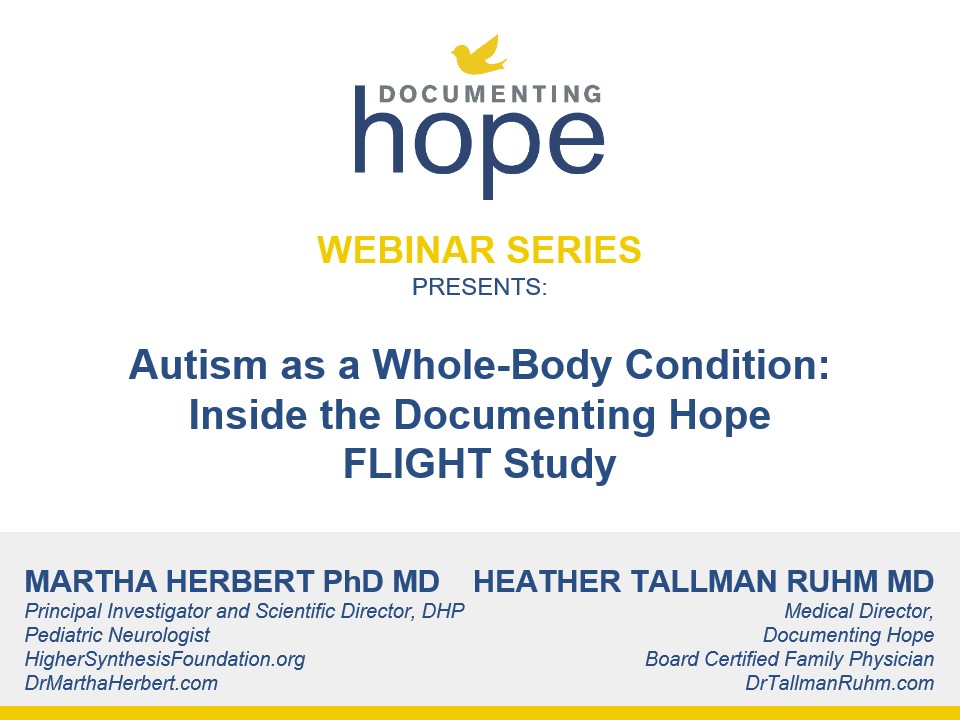
With rising autism rates, the autism rate is now 1 in 36 children. Learn how viewing autism as a whole-body condition can help your child in this webinar interview of Beth Lambert, the Executive Director of Documenting Hope. You can watch the replay below. Please note that you will be asked to provide your email address at the 30-minute mark to continue viewing the replay.
Rising Autism Rates
The autism rate is now believed to be 1 in 36 children, which is 2.8% of children, 4% of boys, and 1 in 20 boys (5%) in California. When Documenting Hope opened its doors in 2009, the autism rate was 1 in 150.
We ARE better at diagnosing autism due to increased awareness and due to better diagnostic tools and tracking, but it simply cannot account for the meteoric increase in children with autism since the 1980s. If we’ve gone from 1 in 150 children in 2009 to 1 in 36 in 2023 due to better diagnosing, this means we “missed” about 1.5 million kids (or 75% of those diagnosable).
Our Senior Scientist, Randy Reiserer, looked at the U.S. Department of Education IDEA data, which documents increases in the services in school provided to children with autism from 2005 to 2019 by state. In this chart, you can see that states were paying increasing amounts for autism services in that time period. States would not have made these payments unless there was a verifiable diagnosis. Thus, these data help prove that rising autism rates weren’t simply due to better diagnosis.
Autism Is a Whole-Body Condition
We have a dramatic and frank epidemic on our hands. So what can you do about it? At Documenting Hope, we look at autism (as well as most other chronic and developmental conditions) as whole-body conditions. By addressing root causes such as toxicity, nutritional deficiencies, gut dysbiosis, inflammation and immune dysregulation, children can heal from the collection of symptoms known as autism. Not all children can or do, but there are far more success stories out there than what you’re probably hearing about.
In This Expert Interview
In this interview, Beth Lambert discussed:
- What’s behind rising autism rates?
- Why should we look at autism as a whole-body condition?
- What is Documenting Hope doing about this?
- What are some success stories of kids that have healed from autism?
- What are some resources people can use to help their child heal?
- What can parents do to help their child heal?
Key Discussions
Rising Autism Rates
Beth Lambert emphasized the sharp and concerning increase in autism prevalence, discussing how rates have leaped from 1 in 10,000 decades ago to 1 in 36 today. She argued that this is not merely due to better diagnosis or changes in diagnostic criteria, and that normalization of these high rates is both inaccurate and dangerous. The conceptual takeaway is that the trajectory is unsustainable, highlighting the need for honest recognition and urgent action regarding public health.
Root Causes of Autism and Chronic Childhood Conditions
Beth discussed the importance of moving away from symptom management toward identifying and addressing environmental and lifestyle root causes. Autism, along with other chronic childhood conditions, is viewed as an interplay between genetic vulnerabilities and a cumulative load of environmental stressors—from chemicals to pharmaceuticals to modern lifestyle factors. The main takeaway is that prevention and reversal lie in understanding and mitigating the cumulative environmental load, not in genetic determinism.
The Role of the Microbiome
Beth highlighted the critical role of gut health and the microbiome in the development and severity of autism and other chronic illness. Overuse of antibiotics, poor diet, and other modern exposures disrupt the diversity and balance of gut bacteria, which in turn affects immunity, neurotransmitter production, and even behavior. The conceptual takeaway is that interventions restoring a healthy microbiome—through diet, limiting disruptive exposures, or (experimentally) fecal microbiome transplants—can have significant positive effects.
Autism as a Whole Body, Not Just Brain-Based, Condition
Beth, drawing on Dr. Martha Herbert’s work, argued that autism is not solely a brain or genetic disorder but a “whole-body” condition that includes metabolic, immune, gastrointestinal, hormonal, and neurological dimensions. This broader framework validates multisystem approaches to treatment and underscores the importance of addressing foundational health areas—such as gut function, sleep, stress, toxins, and metabolic cycles—rather than focusing exclusively on behavioral therapies.
Hope for Recovery and the Power of Community Resources
Beth stressed that improvement, and even loss of diagnosis, can and does happen for some children when root causes are addressed. Numerous healing testimonials illustrate that symptoms can be reversed, especially when interventions are personalized and comprehensive with interventions such as dietary changes, detoxification, therapies, lifestyle, and stress reduction. The conceptual takeaway is that both data and lived experience provide hope, and that parents and practitioners should seek out (and build) informed, supportive communities to help navigate the journey.
Timestamped Overview
09:20 Analyzing autism prevalence rates
13:41 Understanding autism spectrum variability
18:49 Diagnosing trends in younger kids
23:46 Youth fitness and military concerns
28:50 Discussing autism and modern living factors
33:14 Impact of stressors on child health
43:19 Fecal microbiome transplant explained
48:48 Dealing with insomnia and cortisol
51:21 Discussing stress and autism in kids
55:16 Regulating the nervous system
01:02:30 Health coach training program details
01:09:11 Supporting children with autism
01:14:11 Discussing autism dietary changes
01:19:36 Autism diagnoses in 1990s Kuwait
01:25:35 Testing methods in FLIGHT study
01:29:11 Rising autism rates globally
01:34:15 Living with ticks in Connecticut
01:38:47 Using homotoxicology for detox
01:46:35 Understanding food sensitivities and testing methods
01:48:31 Psychological value of microbiome tests
01:52:51 Discussing probiotic supplements and yogurts
About Beth Lambert
Beth Lambert is a former healthcare consultant and teacher. As a consultant, she worked with pharmaceutical, medical device, diagnostic and other health care companies to evaluate industry trends.
She is the author of A Compromised Generation: The Epidemic of Chronic Illness in America’s Children (Sentient Publications, 2010). She is also a co-author of Documenting Hope's Brain Under Attack: A Resource for Parents and Caregivers of Children with PANS, PANDAS, and Autoimmune Encephalitis. She is a co-author of Reversal of Autism Symptoms among Dizygotic Twins through a Personalized Lifestyle and Environmental Modification Approach: A Case Report and Review of the Literature, J. Pers. Med. 2024, 14(6), 641.
In 2009, Beth founded Documenting Hope and currently serves as Executive Director. Beth attended Oxford University, graduated from Williams College and holds a Masters Degree in American Studies from Fairfield University.
Disclaimer
This expert interview is not a substitute for medical advice, treatment, diagnosis, or consultation with a medical professional. It is intended for general informational purposes only and should not be relied on to make determinations related to treatment of a medical condition. Documenting Hope has not verified and does not guaranty the accuracy of the information provided in this expert interview.
Still Looking for Answers?
Visit the Documenting Hope Practitioner Directory to find a practitioner near you.
Join us inside our online membership community for parents, Healing Together, where you’ll find even more healing resources, expert guidance, and a community to support you every step of your child’s healing journey.
Sources & References
Blaxill, Mark, et al. Autism Tsunami: the Impact of Rising Prevalence on the Societal Cost of Autism in the United States. J Autism Dev Disord. 2022 Jun;52(6):2627-2643.
Carey, Benedict. Study Puts Rate of Autism at 1 in 150 U.S. Children. The New York Times, 9 Feb 2007.
Centers for Disease Control and Prevention. Data & Statistics on Autism Spectrum Disorder. Accessed 4 Apr 2023.
Centers for Disease Control and Prevention. Prevalence and Characteristics of Autism Spectrum Disorder Among Children Aged 8 Years — Autism and Developmental Disabilities Monitoring Network, 11 Sites, United States, 2020. Accessed 24 Mar 2023.
Hertz-Picciotto, I., et al. The rise in autism and the role of age at diagnosis. Epidemiology. 2009 Jan;20(1):84-90.
Li, Q., et al. Prevalence of Autism Spectrum Disorder Among Children and Adolescents in the United States From 2019 to 2020. JAMA Pediatr. 2022 Sep 1;176(9):943-945.
Maenner, M.J., et al. Prevalence and Characteristics of Autism Spectrum Disorder Among Children Aged 8 Years – Autism and Developmental Disabilities Monitoring Network, 11 Sites, United States, 2018. MMWR Surveill Summ. 2021 Dec 3;70(11):1-16.
Rosen, N.E., et al. The Diagnosis of Autism: From Kanner to DSM-III to DSM-5 and Beyond. J Autism Dev Disord. 2021; 51(12): 4253–4270.
Treffert, D.A. Epidemiology of Infantile Autism. Arch Gen Psychiatry. 1970;22(5):431-438.
Waterhouse, L. Autism overflows: increasing prevalence and proliferating theories. Neuropsychol Rev. 2008 Dec;18(4):273-86.