
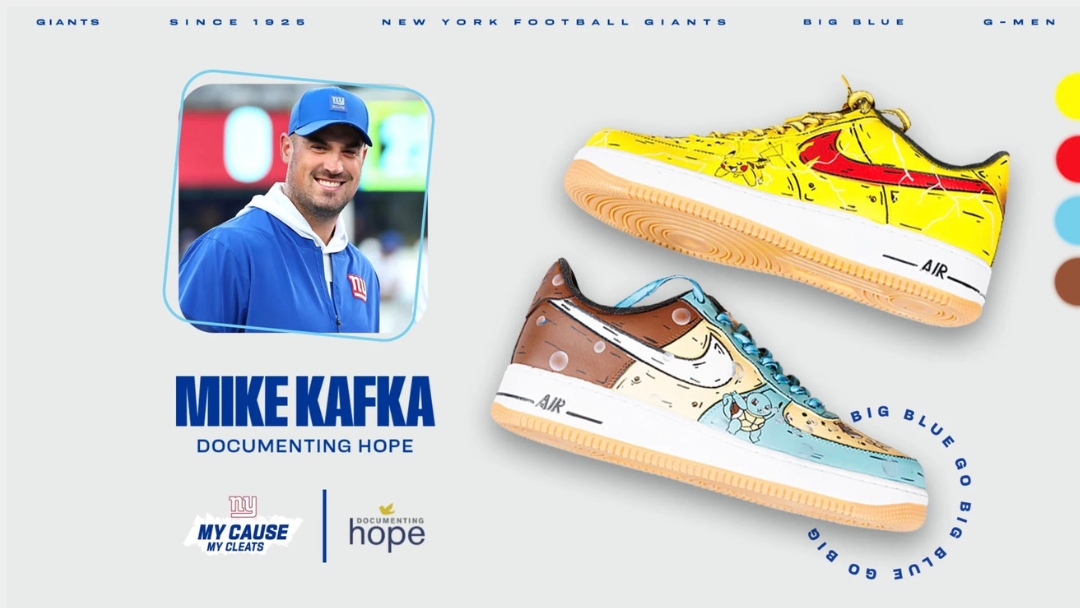
We are honored to be chosen again by the National Football League’s New York Giants Interim Head Coach, Mike Kafka, for his My Cause My Cleats charity of choice! Thank you so much, Coach Kafka!
In an interview on the New York Giants’ website, Coach Kafka was asked: “The NFL is celebrating “My Cause My Cleats” during Weeks 12 and 13. Your sneakers represent Documenting Hope. What is the story behind it?” He replied,
“Really cool. We got introduced to them several years ago. My daughter (Ashton) has juvenile arthritis, and so it’s an organization that is helping do a lot of research that my wife (Alli) looked into and was talking with them. So, we wanted to support them in any way we can and help them raise funds to continue their research on juvenile arthritis, autoimmune disease, things like that. My kids always design my shoes, which are always pretty interesting. We have a great designer, Kato (Mitchell), who does a good job bringing that to life. It’s cool. I enjoy it. I think the players enjoy it. It lets them have their personality on it.”
Coach Kafka said on the New York Giants’ My Cause My Cleats page that he is “proudly representing Documenting Hope to honor children diagnosed with a chronic health condition or autoimmune disorder. Documenting Hope provides educational resources, research, and networking tools that empower parents to embark on a healing journey for themselves and their families.”
To vote for your favorite New York Giants My Cause My Cleats charity, click here, and we hope you choose Documenting Hope! 😉
Click here to learn more about autoimmune disorders, including juvenile arthritis, and click here to read success stories of other children who have overcome their autoimmune disorders.
As always, we appreciate any donations that help us to continue doing this valuable work.
Still Looking for Answers?
Visit the Documenting Hope Practitioner Directory to find a practitioner near you.
Join us inside our online membership community for parents, Healing Together, where you’ll find even more healing resources, expert guidance, and a community to support you every step of your child’s healing journey.
Sources & References
Bahr, L.S., et al. Ketogenic diet and fasting diet as Nutritional Approaches in Multiple Sclerosis (NAMS): protocol of a randomized controlled study. Trials. 2020 Jan 2;21(1):3.
Bisht, B., et al. Multimodal intervention improves fatigue and quality of life in subjects with progressive multiple sclerosis: a pilot study. Degener Neurol Neuromuscul Dis. 2015;5:19-35.
Bourre, J.M. Effects of nutrients (in food) on the structure and function of the nervous system: update on dietary requirements for brain. Part 1: micronutrients. J Nutr Health Aging. 2006 Sep-Oct;10(5):377-85.
Bourre, J.M. Effects of nutrients (in food) on the structure and function of the nervous system: update on dietary requirements for brain. Part 2 : macronutrients. J Nutr Health Aging. 2006 Sep-Oct;10(5):386-99.
Brenton, J.N., et al. Phase II study of ketogenic diets in relapsing multiple sclerosis: safety, tolerability and potential clinical benefits. J Neurol Neurosurg Psychiatry. 2022 Jun;93(6):637-644.
Brenton, J.N., et al. Pilot study of a ketogenic diet in relapsing-remitting MS. Neurol Neuroimmunol Neuroinflamm. 2019 Apr 12;6(4):e565.
Camara-Lemarroy, C.R., et al. Focus on the gut-brain axis: Multiple sclerosis, the intestinal barrier and the microbiome. World J Gastroenterol. 2018 Oct 7;24(37):4217-4223.
Chenard, C.A., et al. Nutrient Composition Comparison between a Modified Paleolithic Diet for Multiple Sclerosis and the Recommended Healthy U.S.-Style Eating Pattern. Nutrients. 2019 Mar 1;11(3):537.
Correale, J., et al. The role of the gut microbiota in multiple sclerosis. Nat Rev Neurol. 2022 Sep;18(9):544-558.
de Goffau, M.C., et al. Fecal microbiota composition differs between children with beta-cell autoimmunity and those without. Diabetes. 2013;62(4):1238-44.
Di Majo, D., et al. Ketogenic and Modified Mediterranean Diet as a Tool to Counteract Neuroinflammation in Multiple Sclerosis: Nutritional Suggestions. Nutrients. 2022 Jun 8;14(12):2384.
Dinse, G.E., et al. Increasing Prevalence of Antinuclear Antibodies in the United States. Arthritis Rheumatol. 2022 Dec;74(12):2032-2041.
Engelenburg, H.J., et al. Multiple sclerosis and the microbiota: Progress in understanding the contribution of the gut microbiome to disease. Evol Med Public Health. 2022 Jun 13;10(1):277-294.
Fan, Y., et al. Dietary Modulation of Intestinal Microbiota: Future Opportunities in Experimental Autoimmune Encephalomyelitis and Multiple Sclerosis. Front Microbiol. 2019 Apr 16;10:740.
Fettig, N.M., et al. Direct and indirect effects of microbiota-derived metabolites on neuroinflammation in multiple sclerosis. Microbes Infect. 2021 Jul-Aug;23(6-7):104814.
Irish, A.K., et al. Randomized control trial evaluation of a modified Paleolithic dietary intervention in the treatment of relapsing-remitting multiple sclerosis: a pilot study. Degener Neurol Neuromuscul Dis. 2017 Jan 4;7:1-18.
Jayasinghe, M., et al. The Role of Diet and Gut Microbiome in Multiple Sclerosis. Cureus. 2022 Sep 9;14(9):e28975.
Kim-Lee, C., et al. Gastrointestinal disease in Sjogren's syndrome: related to food hypersensitivities. Springerplus. 2015 Dec 12;4:766.
Kinashi, Y., et al. Partners in Leaky Gut Syndrome: Intestinal Dysbiosis and Autoimmunity. Front Immunol. 2021 Apr 22:12:673708.
Liu, S., et al. Poor glycaemic control is associated with increased risk of neurodevelopmental disorders in childhood-onset type 1 diabetes: a population-based cohort study. Diabetologia. 2021 Apr;64(4):767-777.
Martinelli, V., et al. Gut-oriented interventions in patients with multiple sclerosis: fact or fiction? Eur Rev Med Pharmacol Sci. 2022 Feb;26(3):935-946.
Melbye, P., et al. Short-chain fatty acids and gut microbiota in multiple sclerosis. Acta Neurol Scand. 2019 Mar;139(3):208-219.
Pitt, D., et al. Glutamate excitotoxicity in a model of multiple sclerosis. Nat Med. 2000 Jan;6(1):67-70.
Pollard, K.M., et al. Mercury-induced inflammation and autoimmunity. Biochim Biophys Acta Gen Subj. 2019 Dec;1863(12):129299.
Sanchez, A., et al. Role of sugars in human neutrophilic phagocytosis. Am J Clin Nutr. 1973 Nov;26(11):1180-4.
Severance, E.G., et al. IgG dynamics of dietary antigens point to cerebrospinal fluid barrier or flow dysfunction in first-episode schizophrenia. Brain Behav Immun. 2015 Feb;44:148-58.
Stagi, S., et al. Determinants of vitamin D levels in children, adolescents, and young adults with juvenile idiopathic arthritis. J Rheumatol. 2014;41(9):1884-92.
Titcomb, T.J., et al. Change in Micronutrient Intake among People with Relapsing-Remitting Multiple Sclerosis Adapting the Swank and Wahls Diets: An Analysis of Weighed Food Records. Nutrients. 2021 Oct 5;13(10):3507.
Titcomb, T.J., et al. Eating Pattern and Nutritional Risks among People with Multiple Sclerosis Following a Modified Paleolithic Diet. Nutrients. 2020 Jun 20;12(6):1844.
Vreeland, A., et al. Postinfectious Inflammation, Autoimmunity, and Obsessive-Compulsive Disorder: Sydenham Chorea, Pediatric Autoimmune Neuropsychiatric Disorder Associated with Streptococcal Infection, and Pediatric Acute-Onset Neuropsychiatric Disorder. Dev Neurosci. 2023;45(6):361-374.
Wahls, T.L. Dietary Approaches to Treating Multiple Sclerosis-Related Symptoms. Phys Med Rehabil Clin N Am. 2022 Aug;33(3):605-620.
Wahls, T.L., et al. Dietary approaches to treat MS-related fatigue: comparing the modified Paleolithic (Wahls Elimination) and low saturated fat (Swank) diets on perceived fatigue in persons with relapsing-remitting multiple sclerosis: study protocol for a randomized controlled trial.Trials. 2018 Jun 4;19(1):309.
Wahls, T.L., et al. Impact of the Swank and Wahls elimination dietary interventions on fatigue and quality of life in relapsing-remitting multiple sclerosis: The WAVES randomized parallel-arm clinical trial. Mult Scler J Exp Transl Clin. 2021 Jul 31;7(3):20552173211035399.
Wahls, T.L., et al. Review of Two Popular Eating Plans within the Multiple Sclerosis Community: Low Saturated Fat and Modified Paleolithic. Nutrients. 2019 Feb 7;11(2):352.
Wang, X., et al. Role of Gut Microbiota in Multiple Sclerosis and Potential Therapeutic Implications. Curr Neuropharmacol. 2022;20(7):1413-1426.
Watt, T., et al. Is Thyroid Autoimmunity per se a Determinant of Quality of Life in Patients with Autoimmune Hypothyroidism? Eur Thyroid J. 2012;1(3):186-92.
Wimalawansa, S.A. Infections and Autoimmunity-The Immune System and Vitamin D: A Systematic Review. Nutrients. 2023 Sep 2;15(17):3842.