
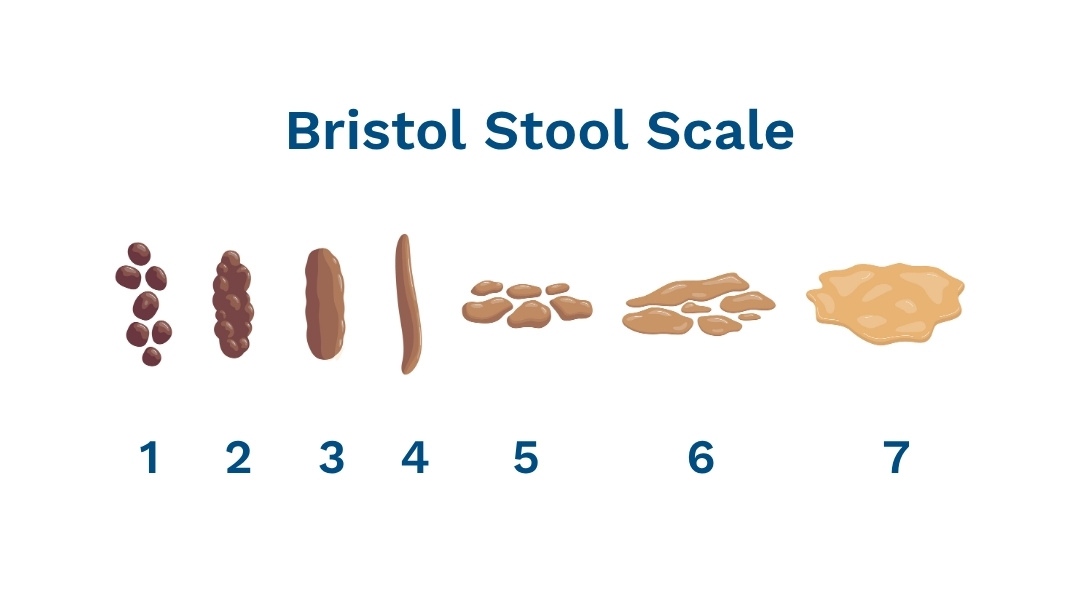
Healthy pooping patterns are an important window into digestive health, hydration status, nervous-system balance, and even gut microbial function. One of the most widely used tools for describing stool form is the Bristol Stool Scale, which categorizes poop into seven types based on shape and consistency. (Please note that poop is called “stool” in the official chart; it’s the same thing.) While all seven types can occur occasionally, some types of poop are considered healthier than others.
What Does Healthy Poop Look Like?
Healthy poop most closely resembles Type 3 or Type 4 on the Bristol Stool Scale. These poops are:
- Formed and cohesive, often described as sausage- or banana-shaped
- Smooth or only slightly cracked on the surfaces
- Easy to pass, without urgency or the need to strain. In other words, poop should slide right out with minimal effort.
In terms of color, healthy poop is typically medium to dark brown, reflecting normal bile production and fat digestion. Variations can occur based on diet (e.g., leafy greens may darken stool, or beets may give a slight pink tint), but persistent pale, black, red, greenish-yellow and greasy or clay-colored stools warrant medical evaluation.
Texture and Consistency of Poop
Types 1-2
Healthy poop should be soft but not loose. It should hold its shape in the toilet but not feel hard or pellet-like. Extremely hard poop (Types 1–2 on the Bristol Stool Scale) can suggest dehydration, low fiber intake, slowed gut motility, slowed metabolism, or sympathetic dominance (such as living in a chronic state of fight-or-flight).
Types 3-4
Types 3 and 4 ideally reflect a well-balanced nervous system, adequate bile and hydration, and a diverse microbial population needed for good nutrition and gut-brain communication.
Types 5-7
Loose or watery poop (Types 5–7) may indicate inflammation, infection, stress, or gut dysbiosis. When there is an alternating pattern of constipation and loose poop/diarrhea, it can be due to encopresis (where loose poop leaks past a blockage of hard stool). As such, constipation may need to be addressed when a previously potty-trained child has loose poop that results in soiled underpants.
What Is a “Normal” Pooping Frequency?
A healthy pooping frequency typically ranges from one to three times per day, as long as the poops are Type 3 or 4. What matters most is regularity and ease, not an exact number of bowel movements per day. It is important to poop every day, however. Experiencing several days in a row without a bowel movement is a red flag and should be evaluated by a healthcare professional.
Despite many pediatricians saying that it’s “normal” to poop once a week, we believe that “normal” is not always “optimal” in terms of health. For example, it may be normal for many children to have constipation and poop only once a week, but this certainly isn’t optimal.
Other Signs of Healthy Pooping
- Minimal odor for poop is a relatively good thing (extremely foul poop can suggest malabsorption, dysbiosis, infection or other issues)
- A feeling of complete evacuation is not only satisfying, but also a good sign
- Healthy poop is not accompanied by pain, burning, or excessive gas
In short, healthy poop is brown, formed, easy to pass, and occurs regularly. Paying attention to poop patterns can offer valuable early clues about digestive, metabolic, and nervous system health, often before more serious symptoms appear. We invite you to learn more about how to heal the gut here if your child doesn’t have healthy poop.
About Beth Lambert
Beth Lambert is a former healthcare consultant and teacher. As a consultant, she worked with pharmaceutical, medical device, diagnostic and other health care companies to evaluate industry trends.
She is the author of A Compromised Generation: The Epidemic of Chronic Illness in America’s Children (Sentient Publications, 2010). She is also a co-author of Documenting Hope's Brain Under Attack: A Resource for Parents and Caregivers of Children with PANS, PANDAS, and Autoimmune Encephalitis. She is a co-author of Reversal of Autism Symptoms among Dizygotic Twins through a Personalized Lifestyle and Environmental Modification Approach: A Case Report and Review of the Literature, J. Pers. Med. 2024, 14(6), 641.

In 2009, Beth founded Documenting Hope and currently serves as Executive Director. Beth attended Oxford University, graduated from Williams College and holds a Masters Degree in American Studies from Fairfield University.
Still Looking for Answers?
Visit the Documenting Hope Practitioner Directory to find a practitioner near you.
Join us inside our online membership community for parents, Healing Together, where you’ll find even more healing resources, expert guidance, and a community to support you every step of your child’s healing journey.