Parenting These Days Is Really Hard
Parenting a child is challenging, especially as many parents no longer have access to nearby relatives that can help them out anymore. Parenting a child in the day and age of smartphones and social media is an additional challenge. Parenting a child with a mood, emotional or behavioral disorder, a neurodevelopmental condition such as autism, ADHD, learning disability or Sensory Processing Disorder, or a psychoneuroimmunological condition such as Lyme disease or PANS/PANDAS is an extra boss-level challenge. Even with extra support, parents are not equipped or taught how to parent their children with any of these conditions. Old-school parenting just doesn’t cut it.
Children’s Nervous Systems Are Overloaded
The reason why old-school parenting no longer works is that many kids are just not alright anymore. Spanking and lecturing are desparately out-of-touch parenting techniques. It’s not that kids choose to act out with tantrums and meltdowns. The real reason behind these behaviors is that their nervous systems are loaded beyond capacity for so many reasons:
With this level of onslaught, no wonder kids don’t feel well! It’s important for parents to understand that a child’s behavior is communication about a stressful trigger or triggers.
Coregulation to the Rescue
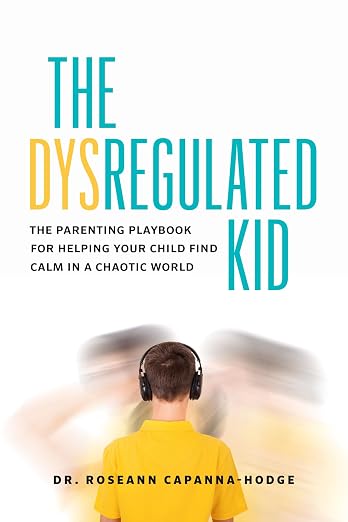
Instead of feeling as if you need to rush out and fix all of these underlying root causes right away, Dr. Roseann introduces the concept of coregulation to parents. This concept means that children rely on our own nervous systems as parents, particularly mothers. If mom is upset or anxious, there’s a good chance their child may be as well. An overloaded child who is acting out just can’t respond calmly and rationally. This is where the techniques in The Dysregulated Kid really shine.
“My own dysregulation–the fear, the worry over what others thought–was contributing too. How could I expect Max to regulate when I was waking up worried every night and looking for ‘the fix?’ I kept thinking there had to be something more. Then I realized that my own anxiety was feeding his behavior. When that clicked, I could see clearly that Max wasn’t broken. He wasn’t trying to embarrass me or be difficult. His nervous system was in overdrive, and we weren’t doing the right things to help it regulate so he could absorb all those darn things we were trying to teach him. I didn’t need to correct him or push him harder to behave–I needed to get him out of the fight, flight, freeze or fawn mode, to teach him how to regulate those big emotions that overwhelmed him every single morning.”
Dr. Roseann’s CALMS Dysregulation Protocol
Because Dr. Roseann has worked with thousands of dysregulated kids, she knows that calming the brain first is key and that everything falls into place after that. Her CALMS Dysregulation Protocol can be used quickly and easily in the moment to achieve a calm parent and calm child. With practice, this habit becomes a way of life and helps your child learn to become regulated.
- C: Co-Regulate First (Breathe and ground to calm yourself)
- A: Avoid Personalizing (Behavior is communication, not a personal attack)
- L: Look for Root Causes (Dysregulation has root-cause triggers)
- M: Model Coping Strategies (Kids learn by watching what you do in stressful situations)
- S: Support and Reinforce (Be consistent to build safety and coping skills)
Remember that the body cannot heal if it is in a state of stress and dysregulation. Remember also that no one learns or behaves very well in a dysregulated state, which begs the question, Are we overmedicating kids simply because they have a dysregulated nervous system? If we could all learn this protocol, would kids need so many mood stabilizers, anti-depressants and/or ADHD medications?
What’s in the Book
Dr. Roseann is a natural storyteller, and she peppers real-life stories throughtout the book to help you understand a point, which makes the material instantly relatable. She sometimes channels her “inner Filomena” (her mother), whom she describes as “could have easily been a mafia hitman” because she only cared about her own family and “truly couldn’t give a crap about anyone else”. You’ll learn to channel your own inner Filomena, too, as you learn in this book how to be your child’s best advocate and nervous system.
The book is well laid out and easy to navigate. Each chapter has a simple parent action step, a section on what parents ask her most about a certain topic and key takeaways that busy parents can scan to get the tldr (too long, didn’t read) if they don’t have time to read the book in a few sittings (although you’ll probably want to). You’ll learn about:
- The biology of dysregulation
- How to use the RESET to Regulate protocol
- Rethinking a clinical diagnosis as nervous-system dysregulation
- Signs of an over- and understimulated nervous system
- Why devices can dysregulate your child’s nervous system
- Proven strategies for smooth device transitions
- A plan for having your child become self-regulated and self-motivated
- Tools to teach coping skills and stress tolerance
After reading the book, it’s easy to see why this book has become an instant best-seller. Dr. Roseann captures all of the major points about why parenting is so much harder today and provides action plans and steps that your own inner Filomena can easily implement.
About Roseann Capanna-Hodge EdD LPC BCN
Dr. Roseann Capanna-Hodge is a leading expert in emotional and behavioral dysregulation with more than 30 years of experience helping families transform chaos into calm. As the creator of Regulation First Parenting® and the CALMS Dysregulation Protocol®, she bridges clinical science with everyday parenting so families can finally understand what’s really driving their child’s struggles.
Specializing in nervous system dysregulation, the root cause of challenges like ADHD, anxiety, OCD, mood disorders, and PANS/PANDAS, Dr. Roseann gives parents and professionals brain-based tools that create lasting change without blame, shame, or guesswork.
Through her bestselling books, The Dysregulated Kid, and top 1% podcast, Dysregulated Kids, she has helped thousands of families support their child’s brain, behavior, and emotional well-being in practical, hopeful ways. Featured in The New York Times, Forbes, and Parents Magazine, Dr. Roseann is on a mission to bring Regulation First Parenting™ to every home, so children can thrive and families can finally feel calm again.
Still Looking for Answers?
Visit the Documenting Hope Practitioner Directory to find a practitioner near you.
Join us inside our online membership community for parents, Healing Together, where you’ll find even more healing resources, expert guidance, and a community to support you every step of your child’s healing journey.
Sources & References
Aggarwal, A., et al. Predominant symptoms in irritable bowel syndrome correlate with specific autonomic nervous system abnormalities. Gastroenterology. 1994 Apr;106(4):945-50.
Altomare, D.F., et al. Slow-transit constipation: solitary symptom of a systemic gastrointestinal disease. Dis Colon Rectum. 1999 Feb;42(2):231-40.
Browning, K.N. et al. Central nervous system control of gastrointestinal motility and secretion and modulation of gastrointestinal functions. Compr Physiol. 2014 Oct;4(4):1339-68.
Campos, J.O., et al. Cardiac autonomic dysfunction in school age children with overweight and obesity. Nutr Metab Cardiovasc Dis. 2022 Oct;32(10):2410-2417.
Chuang, H.H., et al. Weight Status, Autonomic Function, and Systemic Inflammation in Children with Obstructive Sleep Apnea. Int J Mol Sci. 2024 Aug 16;25(16):8951.
Gitler, A., et al. Harnessing non‑invasive vagal neuromodulation: HRV biofeedback and SSP for cardiovascular and autonomic regulation (Review). Med Int (Lond). 2025 Apr 29;5(4):37.
Gullett, N., et al. Heart rate variability (HRV) as a way to understand associations between the autonomic nervous system (ANS) and affective states: A critical review of the literature. Int J Psychophysiol. 2023 Oct:192:35-42.
Karrow, N.A. Activation of the hypothalamic-pituitary-adrenal axis and autonomic nervous system during inflammation and altered programming of the neuroendocrine-immune axis during fetal and neonatal development: lessons learned from the model inflammagen, lipopolysaccharide. Brain Behav Immun. 2006 Mar;20(2):144-58.
Knowles, C.H., et al. Sensory and autonomic neuropathy in patients with idiopathic slow-transit constipation. Br J Surg. 1999 Jan;86(1):54-60.
Knowles, C.H., et al. Slow transit constipation: a disorder of pelvic autonomic nerves? Dig Dis Sci. 2001 Feb;46(2):389-401.
Liu, L., et al. Diagnosis of colonic dysmotility associated with autonomic dysfunction in patients with chronic refractory constipation. Sci Rep. 2022 Jul 14;12(1):12051.
Mazure, M., et al. Autonomic nervous system activity in constipation-predominant irritable bowel syndrome patients. Med Sci Monit. 2012 Aug;18(8):CR493-499.
Michels, N., et al. Gut microbiome patterns depending on children's psychosocial stress: Reports versus biomarkers. Brain Behav Immun. 2019 Aug:80:751-762.
Mizuno, K., et al. Hydrogen-rich water for improvements of mood, anxiety, and autonomic nerve function in daily life. Med Gas Res. 2018 Jan 22;7(4):247-255.
Perrin, C., et al. Transcutaneous Auricular Vagus Nerve Stimulation during Movement Selectively Activates Motor Circuitry without Additional Cortical or Autonomic Effects. J Neurosci. 2026 Jun 24;46(25):e2251252026.
Porges, S.W., et al. Autonomic regulation of preterm infants is enhanced by Family Nurture Intervention. Dev Psychobiol. 2019 Sep;61(6):942-952.
Porges, S.W. Love: an emergent property of the mammalian autonomic nervous system. Psychoneuroendocrinology. 1998 Nov;23(8):837-61.
Raine, A. Autonomic nervous system factors underlying disinhibited, antisocial, and violent behavior. Biosocial perspectives and treatment implications. Ann N Y Acad Sci. 1996 Sep 20:794:46-59.
Speer, K.E., et al. Lifestyle Modification for Enhancing Autonomic Cardiac Regulation in Children: The Role of Exercise. Children (Basel). 2019 Nov 16;6(11):127.